Le Bandit places a surprisingly layered system behind its mischievous raccoon artwork. The board can show current symbols, traces of earlier events and an activation that gives those traces a new role. The most useful way to explain the game is to follow those layers in order, rather than list every feature name without connecting them.
- Board
- 6 columns × 5 rows
- Evaluation
- Cluster pays
- Stored state
- Golden Squares
- Activation symbol
- Rainbow
Specification basis: Hacksaw Gaming product documentation.
The board records a path
Hacksaw describes winning positions becoming Golden Squares after the symbols disappear. A rainbow can activate those positions, producing values or special objects. Clovers modify neighbouring cells and pots collect values in a stated order. Feature variants change how long the marks persist.
This creates a useful separation between location and contents. The current symbol may be new, while the position carries history from an earlier event. A screenshot that shows only the foreground icons would omit part of the state needed to understand the next transition.
Activation is a separate step
A mark and its activation are not the same event. The distinction is similar to a highlighted item awaiting a separate operation in an ordinary software interface. The highlight records eligibility or state; it does not mean that the later operation has already been completed.
The clearest explanation therefore uses an event sequence: establish the marks, identify the activation and then show the resulting objects. This is a description of the rules, not a way to influence them. It also explains why two boards with similar icons can represent different stages.
Order matters when objects modify each other
Collection systems become more difficult to read when one object changes another before a final total is resolved. The developer's ordering information is significant because the sequence can determine which values are present when the next operation occurs.
A non-game arithmetic example shows the issue: applying ‘add 2’ before ‘multiply by 3’ to the number 4 gives 18, while reversing those operations gives 14. The example is not a Le Bandit result. It simply demonstrates why an explanation should preserve the published order instead of summarising every effect as a generic increase.
Three useful distinctions
| Term | What it describes |
|---|---|
| Golden Square | A position carrying remembered state. |
| Rainbow | An activation event for relevant marked positions. |
| Persistence | How long that state remains applicable. |
Persistence distinguishes the feature variants
The published variants differ in the duration of the marked positions and their activation behaviour. That makes persistence a more useful organising term than a vague hierarchy of ordinary and enhanced features.
An editorial comparison can ask a concrete question for each state: what is retained after this event? The answer helps explain the next frame. It does not imply that accumulated marks determine future random symbols. A retained board is readable history, not a forecast.
The raccoon gives the system an identity
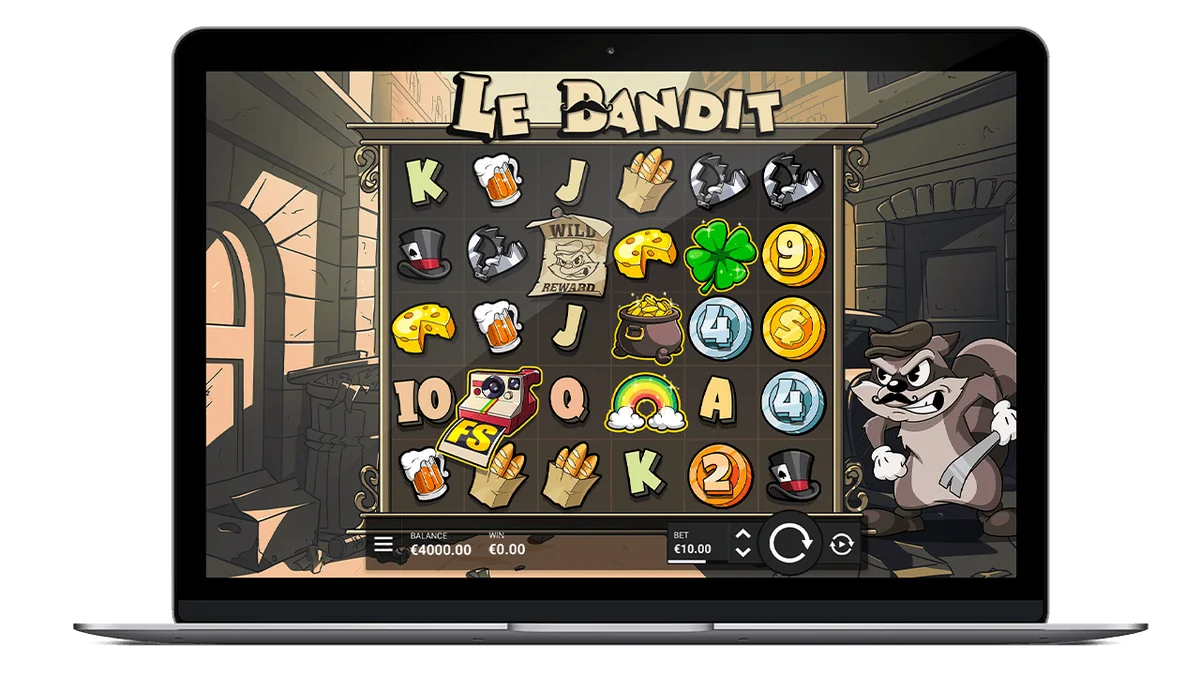
The raccoon, clovers, rainbow and pots create an intentionally eclectic visual language. Each object can act as a mnemonic, but the relationships still require explanation. A pot suggests collection; a highlighted square by itself is more abstract.
The official screenshot is useful for locating these concepts spatially. Our analysis places text outside the image and gives the main terms their own table. This avoids requiring a reader to infer every rule from miniature labels or from a busy animation. The strength of the design is its layered state; its explanatory challenge is the same layering.
Questions about Le Bandit
Are Golden Squares ordinary symbols?
They describe marked board positions, so they should be distinguished from the icons occupying those positions.
Why does collection order matter?
When one operation changes values used by another, reversing the order can change the result.
Does a full-looking board show what comes next?
No. It documents the current state and does not establish future random events.
Source notes
The feature descriptions refer to Hacksaw Gaming’s documentation for Le Bandit. The interface analysis is our editorial interpretation. Source material checked on 24 September 2026.
Game imagery: Hacksaw Gaming. Read about sources, illustrations and review scope.